












A REFLECTION ON FAMILY GROUP SIZE IN SOCIETY AND CHILDREN’S RESIDENTIAL CARE - PATRICK TOMLINSON (2026)
Date added: 27/06/26
Download a Free PDF of this article
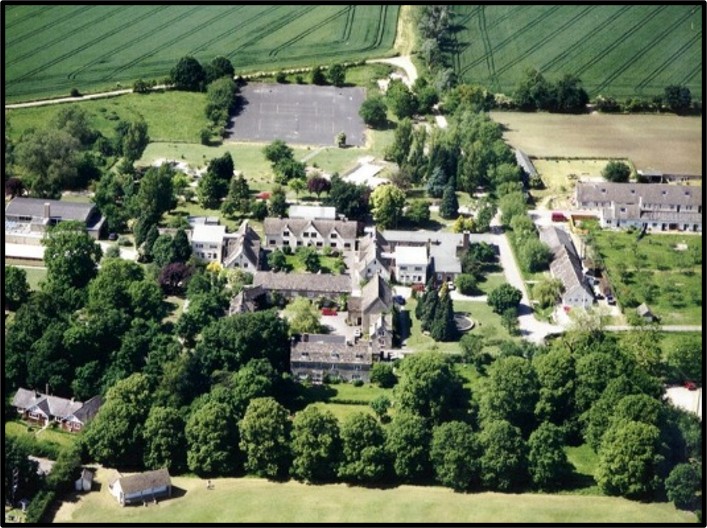 Acknowledgements: I would like to thank Sean Dunne for this article, as the ideas emerged in discussion with him this year on a subject we have considered for many years.
We first worked together, around 35 years ago, in a residential therapeutic community for boys in England, The Cotswold Community. The Community was situated on a 360-acre farm in Wiltshire, England. There is much information and literature on the work of the Cotswold Community (see www.johnwhitwell.com).
I would also like to acknowledge Lar de Nossa Sr.ª do Livramento for their commitment to continuous quality improvement in therapeutic services for children and young people, which I have experienced with them since 2018. Thank you also to the Technical Director of Livramento, Maria João Braga da Cruz, for the kind permission to include the section of the article that refers to the work of Livramento.
This article is also linked in its themes to,
Emma Blakemore, Sir Martin Narey, Patrick Tomlinson, and John Whitwell (2022) What is Institutionalising for ‘Looked After’ Children and Young People?, in, Journal of Social Work Practice, Taylor & Francis,
A PDF of the two articles can be downloaded below.
Abstract: This article talks mainly about the UK and Ireland, but the points are more widely relevant. The focus is on the relationship between the reduction in family size over the last 100 years and the similar pattern in children’s residential care. The article discusses important themes in child development and their relationship with living in groups. These themes are considered from different perspectives and areas of research. The article argues that it becomes increasingly difficult to advocate and believe in group living when the experience of it has been dramatically reduced, especially in some societies. This difficulty may continue to be costly on many levels: for children’s development, well-being, and recovery from trauma; the professional development of group work skills and their many benefits; and the significant financial burdens involved. The paper provides a positive and hopeful example of a children’s group living context.
Introduction
From 1967 to the 1990s, boys at the Cotswold Community, where I began work, lived in groups of 10 in 4 separate homes. At the time, this size of home or community was not so unusual in the UK. Woodhouse (2026) asks the question, with the title of his book, The Perfect Little Children’s Home? Understanding Why Homes are Getting Smaller?
Woodhouse points out that a 2016 independent review of residential care raised concern that the average number of children per home in the UK had dropped to 4, setting out that this was more costly and there was no evidence it was better for children. Since that time, the average has dropped further to 2.9 children.
It seems scarcely believable that this is now the average size of a home. In the UK and Ireland, many children are living on their own in children’s homes or with one other child. Woodhouse’s book elaborates in detail on the many factors for this numerical decline. One that he mentions is risk aversion.
Prophetically, Maher (2003, p.280) wrote in his excellent paper on residential care in the UK, which discussed some of the benefits and challenges of group living, among other issues,
Some of them (children) still get referred to therapeutic communities. More of them, however, bypass this sector and are placed in ones or twos in houses over the south of England, maintained through having a staff team, often recruited through agencies, devoted entirely to keeping them ‘safe’, by virtue of keeping them apart from other young people. They have been deemed impossible to live in a group, and the result is that the powerful forces mobilised by group living and group educating are removed – envy, conflict, sexual attraction, and adolescent destructive group processes. Their teeth are pulled. When this happens, the chances of moving them on to somewhere where treatment can happen become remote indeed. Treatment is risky, difficult, and painful for everyone involved - and often too risky, difficult, and painful to attempt.
In 2003, the word treatment meant therapeutic care that enables recovery from trauma. One way of addressing this difficult work is potentially to eliminate it. And that has been one of the agendas in relation to residential group care for children during the last 20-30 years. Henderson (2024) has highlighted that the risk that Maher refers to is not only seen to be related to the size of the home but also to the whole residential care sector. The title of Henderson’s book is Challenging the Conventional Wisdom about Residential Care for Children: A Good Place to Grow. Underpinned by vast research, he shows that there has been a misleading, incorrect, and harmful representation of residential care for several decades. Decisions about whether a home can operate or not, whether it be a foster care home or a small or larger residential care home, should be based on the evidence of whether children do well or not. Blakemoore, Narey, Tomlinson, and Whitwell (2022) argued,
Essentially, so the theology goes, the larger the home, the more institutionalised it’s likely to be. The evidence doesn’t support this, certainly not when we’re talking about the difference between, say, a three-bed and a six-bed home.
The risks of many things in residential care have been reduced for children and adults. For example, the risk of aggression between children is reduced if there isn’t anyone to be aggressive with besides the adults. A bit like it is hard to have sibling rivalry if you don’t have any siblings. As the neuroscientists Shonkoff and Phillips (2010, p.10), who were advising the US Government, argued,
Interventions that work are rarely simple, inexpensive, or easy to implement.
The importance of children’s peer and sibling relationships
We know that healthy development requires relationships, not just between adults and children, but between children. Peter Gray (2025), in an article discussing children’s play and how it is often being curtailed, argues,
In a discussion of such research, one child development specialist (Judith Harris, 1989, p.161) noted that the popular phrase “It takes a village to raise a child” is true if interpreted differently from the usual Western interpretation. In her words: “The reason it takes a village is not because it requires a quorum of adults to nudge erring youngsters back onto the paths of righteousness. It takes a village because in a village there are always enough kids to form a play group”.
It has never been said that it takes a village of adults. By denying children who are already deprived by being taken into care the opportunity to benefit where possible by living in groups, and I don’t think of 2 as a group, they are deprived of the important opportunity of peer relationships. Removing risk can have the side effect of creating other risks or unintended consequences. For example, ultra-clean environments can reduce immunity.
 Roman Children Playing c.2nd century (© Marie-Lan Nguyen, 2024)
Shonkoff and Phillips (2000, p.165), among many other have shown that establishing relationships with other children is one of the major developmental tasks of early childhood, and it also has a significant impact on future development. They argue that the quality of peer relationships in early childhood is one of the key factors that influence long-term outcomes into adulthood.
Mason (2007) suggests that peer contacts must be prioritised in residential care and refers to research indicating that, often contrary to adult priorities, this is the outstanding priority stated by young people. So, what else makes it so hard to see the value of groups, especially when homes in the UK with 1-2 children and staff teams of up to 10 or more, that can cost £300,000 to a million pounds per year for one child (UK Parliament, 2026), in a nation that has been living in austerity?
This point emerged in discussion with Sean, and we think it is very relevant. Trends are ultimately determined by an overlap of thinking in societies and individuals, and it is difficult for anyone, including political leaders, to think outside of their personal experience. To value the benefit of a group, it can be argued that positive group experiences in our formative years would be helpful.
If you were born post-WW2, probably until the end of the century, in the UK and other nations, you would have most likely known of people in your extended family who had anywhere between 5 and 10 siblings. Not everyone in the family, but at least some examples. Probably most of the people seemed ok and not damaged by growing up in a large sibling group. If there were over 5 siblings, and certainly if there were 8 or more, the older children would take on some responsibilities in the home. Children also, in the best of circumstances, would learn to care for each other and play together.
In these situations, the children’s opportunity to contribute something helpful to another is easily available. Contributing is the essence of mattering (e.g., Prilleltensky, 2020). Mattering extends from being seen, heard, and valued, to contributing to others. An example of this might simply be a caring and thoughtful gesture to another or helping with daily chores. It is argued that this is often what is most important to us: the sense that we make a meaningful contribution and positive difference.
Children growing up in groups have a much greater sense of mattering to others, simply by the fact that contributing is part of everyday life. It is the opposite of the modern-day concept of growing up in a ‘helicopter parent’ environment. If we deprive children of opportunities to contribute, and hence to matter, one consequence may be a higher likelihood of futility and depression.
Reduction in family group size
The work of Bruce Perry (2006, p.233), the trauma specialist and neuroscientist, was the first that I read that made the changes in family group size so clear. This is a long quote, but the detail is important and helpful,
The modern world has disrupted and in many cases abandoned the fundamental biological unit of human social life: the extended family. There has been so much emphasis on the breakdown of the nuclear family, but I believe that in many cases the extended family, whose dissolution has been much less discussed, is at least as important.
… For countless generations humans lived in small groups, made up of 40 to 150 people, most of whom were closely related to each other and lived communally. As late as the year 1500, the average family group in Europe consisted of roughly twenty people whose lives were intimately connected on a daily basis. But by 1850 that number was down to ten living in close proximity, and in 1960 the number was just five. In the year 2000 the average size of a household was less than four, and a shocking 26 percent of Americans live alone.
As technology has advanced, we have gotten farther and farther away from the environment for which evolution shaped us. The world we live in now is biologically disrespectful; it does not take into account many of our most basic human needs and often pulls us away from healthy activities and toward those that are harmful.
The same trends exist in many nations. In some cases, as extended families have reduced and separation rates between parents have increased, many children are growing up in very small family groups and networks. Some may barely have any sense of a network. Someone in their 40s today was born and grew up in a very different era from the one we live in now, so the reference points that shape our thinking have shifted dramatically.
The importance of our formative years is mentioned, as experiences in these years can have a deep impression. What we don’t experience in early childhood, we can experience and learn from as we grow up and as adults. If one grew up in a functional family group with extended family, one’s confidence in groups would likely be affected by the experience. As would one’s appreciation of the value and benefits.
The relevance to residential children’s homes
The idea of working in homes with 10 children was not a shock to me when I started in 1985. However, the experience that unfolded in my first year was more of a shock. One clear thing was that you had to learn how to work in a group. On average, there were 4 adults in the home with 10 children. In a group that size, there are 91 possibilities of unique 1-1 relationships. If we have 2 children and 3 adults, there are just 9 possibilities and only one child-to-child relationship.
The complexity is vastly reduced, which reduces one type of risk. However, I would much prefer a variety of children to be with rather than be with just one. There is so much more to learn, and naturally, some children will get on better with different adults and children. The benefit of learning how to live within a familial social environment is reduced. At least twice, I have experienced young people who were made to live on their own asking for another child to be placed with them. As one 15-year-old put it,
Why can't I live with anyone else? Do they think I’m some kind of monster?
As well as being the only young person in the home, young people such as this often find themselves deemed to require what is termed in the UK and Ireland, 2-1 staffing, which means there must always be 2 adults available. This means that the total staff team is often 10 or more for one child. In addition, the home manager and sometimes the deputy are usually not included in the 2-1 staffing, but may be in the house carrying out administrative responsibilities. So, the young person can find themselves in the home with 4 adults.
It could be argued that the move to these types of placements is another form of institutionalization, at the opposite end of the spectrum to the large institutions of the past. Anglin (2002) found in his research that what young people who are living in residential care want most is a sense of normality. Some of the current practices in the UK and Ireland have moved further away from what could be considered ‘normal’. In their paper, What is Institutionalising for ‘Looked After’ Children and Young People?, Blakemore, Narey, Tomlinson, and Whitwell (2022) state,
Becoming institutionalised usually means becoming removed from the norms of society. So, an institutionalised person does not know or understand the expectations, rules, and norms of ordinary society.
Not only are some of these practices institutionalizing, but they also deprive everyone involved of the benefits of living in a group. Learning about groups, if one is interested, has so much value to all kinds of situations in life, work, and leadership, for example. But if we do not grow up in groups and if, in social care work, we cannot experience group living and work, how can it be learnt? The value of group care becomes an alien concept, and soon, in the UK, there may be a generation of residential care workers who have never worked with a group of children.
Along with the concept of 2-1 staffing, this leads to a situation where adults can become afraid of being with a young person on their own and are deskilled when it comes to the complexity of working with a group. With an increasingly high number of social care professionals with little or no group living experience and skills, there is a risk that the small size of children’s homes becomes a self-fulfilling prophecy.
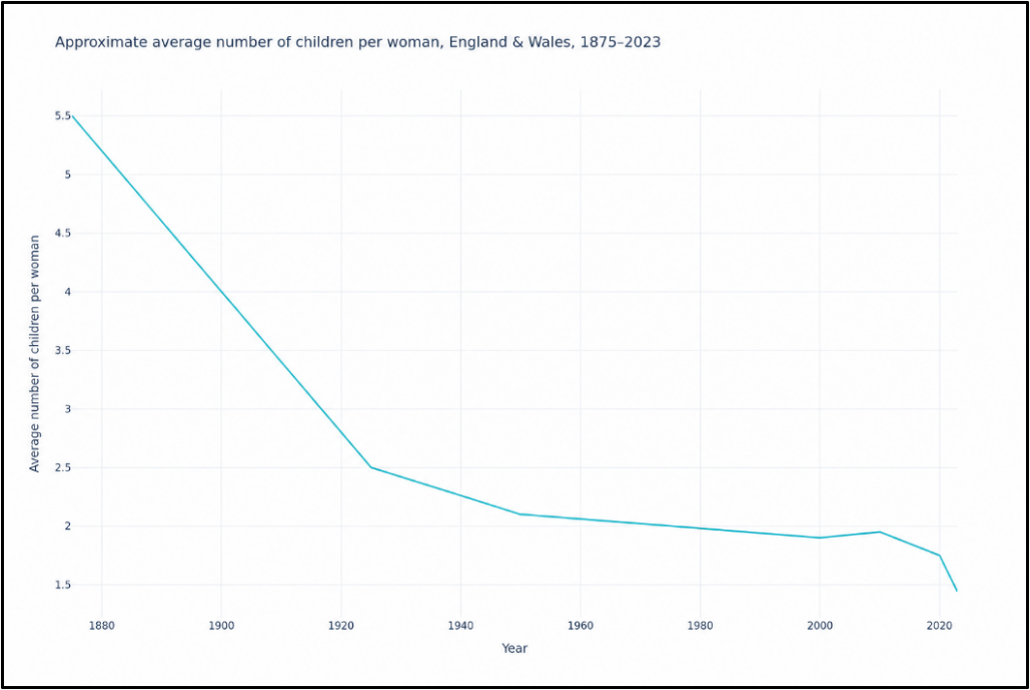
Group living children's homes still exist, and thankfully, there are excellent examples in the UK and other nations. But as Woodhouse has drawn attention to, it is hugely diminished, just as Perry has said about family group sizes. The following 2 graphs illustrate this point about the reduction in familial group sizes in UK society and residential care.
The first shows the UK numbers of children per woman from 1875 to 2020. The key point is that from 1875 to 2020, the average has decreased from 5.5 to below 1.5 children per woman.
The next graph shows the change in residential care home size during the same period.
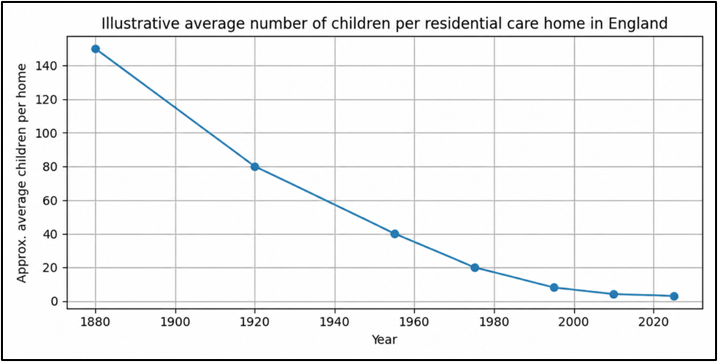
The key point about the size of children’s homes or institutions, as they would have been, is that they have gone from over 140 in 1880 to 2.9 per home in 2020.
When group living disappears from everyday life
Together, the graphs show that the reduction in family and children’s residential home size has followed a very similar pattern over the last 100 years. Clearly, it must be hard to advocate for group care if it is far less common in life. And this bias is most likely unconscious. We tend to advocate more easily from a position of experience and familiarity. What we know makes more sense to us than the unknown. The reduction in group size in residential homes may be partly because residential care has followed the cultural norms of the last 100 years. Naturally, confidence in group living decreases the less we experience it.
Looking at these trends does not seem to present a hopeful picture if, as Perry argues, living in groups is biologically respectful and essential for human wellbeing. Other researchers, such as Susan Pinker (2014, 2015, 2017), have argued that social integration is the number one influence on healthy living and longevity. We need opportunities to integrate from birth onwards. When that has not worked well or has even broken down disastrously, we must provide this opportunity. Integration into a ‘family group’ is the first step towards social integration. This is where our first experiences of connecting, belonging, and mattering take place.
Knock-on effects
There are additional knock-on effects of the reduction in group size. The number of children living in residential care in recent years has gone up, and with the reduction in the size of groups, inevitably, there has been a significant increase in the number of homes. A 15% increase from 3500 to 4000, as estimated by Ofsted in the last year alone. This means a great demand on the number of managers, staff, and other resources. Charles Hunter Associates (2024) claims,
In the last 10 years, the number of children’s homes has increased by 70%, although the number of spaces available has only increased by 25%.
These changes mean a great demand on the number of managers, staff, and other resources. The extra managers and staff have to come from the same pool of experienced workers. This means that inexperienced staff must be found. Especially due to the shortage of managers, the bar regarding quality is likely to be lowered. This has led to growth in the social staffing agency sector due to the demand to meet staff shortages. The potential reliance on agency staff who are not permanent members of a care team is an additional risk to quality. Writing for the UK journal, Children & Young People Now (CYP), Simpson (2022) argues,
CYP Now investigation shows 10-fold rise in agency social work teams being used by local authorities in the last five years, with children’s services leaders saying staff shortages are placing huge pressure on budgets
Along with losing the economies of scale that can be achieved with larger groups, costs inevitably increase for many reasons, such as those above. Another example is when several small homes that are part of one organization are spread over large distances, sometimes up to 100 miles apart. This means additional time and money spent keeping a sufficient connection with each home. The homes are more isolated than when all organizational support resources are close by. This reduces feelings of safety and security, which are far easier to achieve with closer proximity to support. I think it is one of the reasons why the police are sometimes, but not always, used as a backup form of management, which also reduces a feeling of authority and safety.
AN EXAMPLE OF POSITIVE GROUP LIVING IN A LARGE CARE HOME
Lar de Nossa Sr.ª do Livramento, Porto, Portugal
We will end on a hopeful note. Since 2018, I have been working with this children's residential home, and have visited numerous times, the last being in May this year. On my first visit, I was struck by several things, and over the years, I have understood these points more clearly.
1. Collective creativity within finite resources
There is a relative lack of money, compared with care organizations in the UK and Ireland. The funding is significantly lower than in the UK, for example. On average, the funding per child is around €48,000 per year. The budget available is very tight to live within. In the winter, it was noticeable how cold it could be and how expensive it would be to heat. However, what these circumstances lead to is resourcefulness, collaboration, and creativity in problem-solving. Lack can be a good thing if it does not slide into serious deprivation.
Isabel Menzies Lyth, who was the Organizational Consultant at the Cotswold Community in the 1970’s to early 80s, had an interesting view on the potential therapeutic value of scarcity. During this time at the community, it was decided to close the central kitchen, which cooked all the meals for the 4 homes. Instead, meals were to be provided from within each home. As food has such a key role in therapeutic care, this was a huge change. When the food was provided from outside of the home, there were often complaints from the boys and adults about the quality and there not being enough. Menzies Lyth (1985, p.240) explains some of what happened during this change.
In time, there were a number of very positive effects of this change. The house mothers visibly grew in authority and stature as they faced and accepted the new challenge and, for the most part, very effectively took over the task of food provision. The task itself was more realistically and effectively performed. One heard less and less about scarcity, and the boys were actually better fed. Most importantly, the confrontation with scarcity and complaints about ineffective provision now became a face-to-face matter between the house mother, her colleagues in the house and the boys. The boys were thus given an important learning experience for life in the world outside: in learning to deal with scarce resources themselves, not just to complain about them. Initiative and ingenuity were freed… The therapeutic effects of the change in the staff (role) models presented and in the participation of the boys in the new system can hardly be exaggerated.
This is highly relevant to my experiences at Livramento. It is the life-affirming richness of a group of young people and adults working together to make the best use of the resources available and to find creative solutions to problems. As Menzies Lyth said, Initiative and ingenuity are freed.
2. The value of group living
The second point is that there were up to 40 girls living under the same roof, albeit in 5 self-contained groups of 8, and it is a large building.
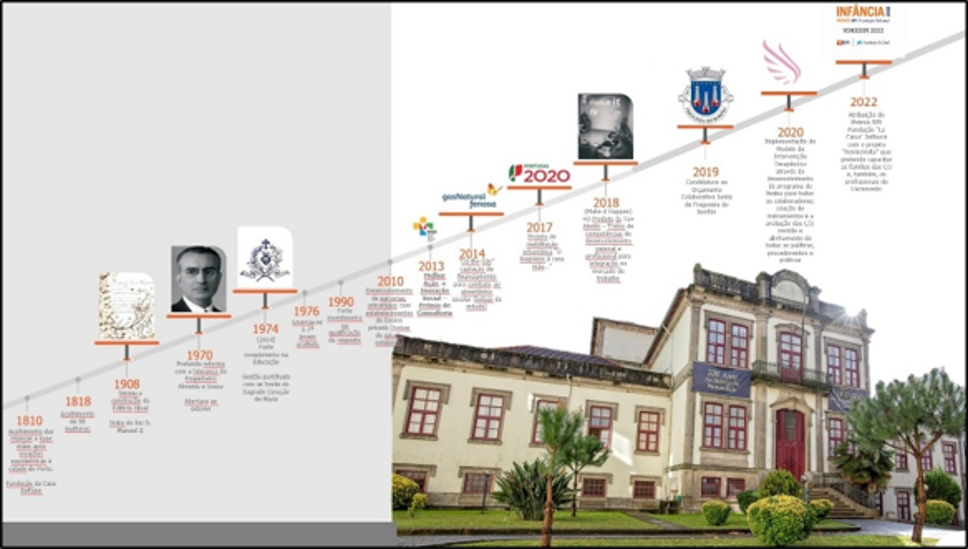
(The Livramento Home and its timeline as a care home, which began in 1810)
So, the girls have their groups of 7-8, within a large group of 30. There are also two apartments close by, for groups of 4 and 5, where young people can stay until the age of 25. It is genuinely like an extended family network in the way Perry (2016) described.
For example, they have small group meetings, like a family, and large group meetings, like an extended family, throughout the year. As children progress at Livramento, they may move from one group to another that allows more autonomy. But they will regularly see the adults who have been closely involved with them before. This might be a passing moment, a quick hug, or catching up with what is happening, good wishes for an important event, etc. A bit like bumping into an aunty or grandparent.
As the girls and all the staff are in the same place, it is an economical model. But more relevantly, each girl will see several adults every day who are familiar to them and who have played a role in their journey. Perry (2006, p.80) states,
In fact, the research on the most effective treatments to help child trauma victims might be accurately summed up this way: what works best is anything that increases the quality and number of relationships in the child’s life.
On my recent visit, one of the girls whom I first met in 2019 was chairing a group meeting with 7 children and 2 adults in it. As well as doing this very well, she also stopped from time to time to explain to me in English what was happening. She introduced the agenda and took the minutes. Processes such as this, alongside the daily living together, provide great opportunities for the development of empathy, thoughtfulness, and care. As Richard Rollinson (2025), who was the Director of Mulberry Bush, a therapeutic residential school in England, has said,
You come to the Mulberry Bush School to learn to live with yourself and to live with others.
Very recently, one of the girls also chaired a whole community inter-group meeting, with representatives from each children’s group, the care workers, the senior team, and the Board of Administration. They discussed all relevant and some complex issues in the life of the organization. Girls from the same home have also connected with national and international children’s networks, contributing to conferences and discussions.
3. Stability, continuity, and growing autonomy
The long-term hurt that many children who live in residential care have suffered requires some long-term work (Rollinson, 2025). Several girls have lived at Livramento for 5 -10 years. It is also possible to stay until 25 years old. Recently, the possibility of moving into supported apartments a few minutes from the main home has been added. One young adult described this transition as ‘being like having one foot in and one foot out’. Much like a healthy transition when a young person leaves home for the first time. Many girls who have lived at Livramento for a long time have done very well: achieving degrees and other qualifications, jobs, and generally doing well in life.
Some of the above, such as large groups and long stays in residential care, are what some call institutional. To me, if it is done well, it is more like what Perry refers to as a functional large network of connected people who feel that they matter and belong. They are also allowed genuine stability for years, like ordinary children. In some ways, this is less institutionalizing. It is evident that the girls feel cared for and loved.
Conclusion
While there is a risk of losing group relational skills in the residential child care sector, if we believe in the benefits and can manage the anxiety of risk better, the capacity is there to reverse the trend. Even if we don’t have so much direct experience in group living, history, human creativity, and imagination may lead us to a new pioneering stage of development in residential care for children.
References
Anglin, J. (2002) Pain, Normality, and the Struggle for Congruence: Reinterpreting Residential Care for Children and Youth, New York: The Haworth Press Inc.
Blakemoore, E., Narey, M., Tomlinson, P. and Whitwell, J. (2022) What is Institutionalising for ‘Looked After’ Children and Young People?, in, Journal of Social Work Practice, Taylor & Francis, https://www.tandfonline.com/doi/abs/10.1080/02650533.2022.2034766
Charles Hunter Associates (2024) A Breakdown of Children’s Social Care in England 2024, https://www.charecruitment.com/blogs/a-breakdown-of-children-s-social-care-in-england-2024
Gray, P. (2025) The Culture of Childhood: We’ve Almost Destroyed It. Children Learn the Most Valuable Lessons With Other Children, Away From Adults,
https://www.psychologytoday.com/us/blog/freedom-learn/201610/the-culture-childhood-we-ve-almost-destroyed-it
Harris, J. R. (1998) The Nurture Assumption: Why Children Turn Out The Way They Do, New York: Free Press
Henderson, B. (2024) Challenging the Conventional Wisdom about Residential Care for Children: A Good Place to Grow, London and New York: Routledge, Taylor and Francis Group
Henderson, B. (2025) Podcast with Colby Pearce, Secure Start,
https://www.youtube.com/watch?v=zm-himEnMI8
Maher, M. (2003) Therapeutic Childcare and the Local Authority, in, Ward, A., Kasinski, K., Pooley, J., and Worthington, A. (2003) Therapeutic Communities for Children and Young People, London and New York: Jessica Kingsley Publishers
Mason, J. (2007) A Child’s Standpoint: Needs in Out-of-Home Care, in, Children and Society, vol. 22, 358-369
Nguyen, M. (2024) Roman Children Playing
Perry, B.D. and Szalavitz, M. (2006) The Boy Who Was Raised as a Dog: And Other Stories from a Child Psychiatrist’s Notebook, New York: Basic Books
Pinker, S. (2014) The Village Effect: How Face-to-Face Contact Can Make Us Healthier and Happier, Canada: Random House
Pinker, S. (2015) The Village Effect
https://www.youtube.com/watch?v=CCs7o5KUAW4
Pinker, S. (2017) The Secret to Living Longer May Be Your Social Life
https://www.youtube.com/watch?v=ptIecdCZ3dg&t=217s
Prilleltensky, A. and Prilleltensky, O. (2021) How People Matter: Why It Affects Health, Happiness, Love, Work, and Society, Cambridge University Press
Rollinson, R. (2025) Podcast with Colby Pearce, Secure Start,
https://www.youtube.com/watch?v=3mSkItMMyxA&t=17s
Shonkoff, J. and Phillips, D. (eds) (2000) From Neurons to Neighborhoods: The Science of Early Childhood Development, National Academies Press: Washington DC
Simpson, F. (2022) Recruitment Agency Practices Compound Workforce Pressures, in, Children & Young People Now, 26th July 2022,
https://www.cypnow.co.uk/content/analysis/recruitment-agency-practices-compound-workforce-pressuresUK Parliament (2026) Financial Sustainability of Children’s Care Homes: Sixty-First Report of Session 2024–26,
https://publications.parliament.uk/pa/cm5901/cmselect/cmpubacc/1233/report.html
Woodhouse, J. (Ed.) (2026) The Perfect Little Children’s Home? Understanding Why Homes are Getting Smaller?, Dialogue, https://dialogueltd.co.uk/perfect/
Files
- Download a Free PDF of this article
- Download a free PDF of, What is Institutionalising for ‘Looked After’ Children and Young
Please leave a comment
Next Steps - If you have a question please use the button below. If you would like to find out more
or discuss a particular requirement with Patrick, please book a free exploratory meeting
Ask a question or
Book a free meeting