












STAFF SELECTION INTERVIEW QUESTIONS & PROCESS GUIDELINES - PATRICK TOMLINSON 2026
Date added: 18/01/26
Download a Free PDF of this article
ACKNOWLEDGEMENT: I would like to thank the Moore House Group and its Founder, Mrs. Patricia Sheridan in Scotland (https://moorehousegroup.org.uk/), who commissioned me to review their staff selection process. And the Moore House CEO, Dr. Stephen Drysdale, who has kindly given me permission to use and share this material, much of which emerged out of our work together.
ABSTRACT: I have been interested in the issues of staff selection and development since early in my career over 35 years ago. Selection and development are intertwined, and if an organization does well with both, it is a key factor in the creation of a high-quality organization. This article focuses on the selection interview process. The questions, how they are asked, and scored are especially important.
In 2024, Moore House Group in Scotland, who run residential and other services for children and families, asked me to work with them in reviewing and redesigning every aspect of their selection process, from job advert to appointment. It was felt that this would most likely improve staff retention. I am told by Moore House that in the 1 ½ years since we finished the project, staff retention significantly improved for recruits. Hopefully, this will be sustained.
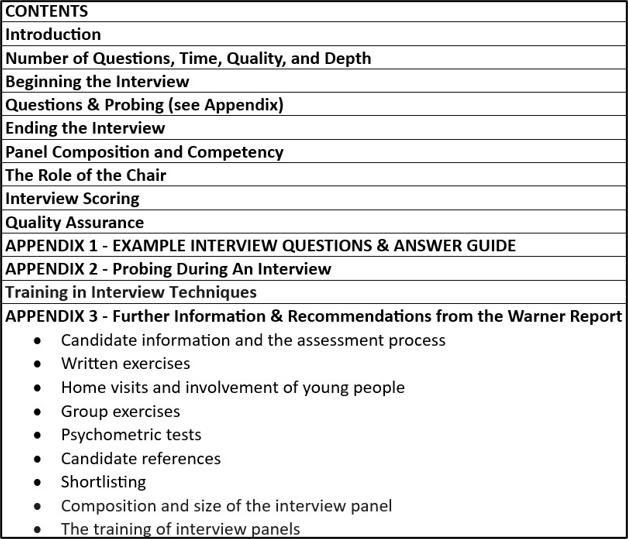
INTRODUCTION
- Most of the example questions in this document can be adapted to different levels of positions, ranging from a care worker to a team lead, to a service manager, to a senior manager. Some of them are also relevant to all organizational roles.
- There may be other questions that should be added, due to regulations, good practices, specific job requirements, etc. A few minutes at the beginning of the interview, exploring the candidate’s CV, can also be helpful. It can also be helpful to ask the candidate if they have any questions at the end.
- Some of the questions are more suited for junior-level positions, and some for seniors.
- Some of the questions could be used as a written exercise. For example, give the question and ask the person to write their answer to this question during the next 30 minutes.
Number of Questions, Time, Quality, and Depth
There has been a view from some research that the typical job selection interview is no more effective than tossing a coin (Warner, 1992, p.45). It is vital to do everything possible to improve the success rate. Getting the interview process right is crucial to an effective selection process.
• Each question must be designed to be clear, focused on a key issue, and open-ended enough not to give away the answer.
• The main point is to ask questions that get to the depth of the candidate’s experience, thinking, and approach.
• To do this, time is needed to explore the questions.
• Anything between 1 and 1.5 hours might be most effective.
• Fewer questions with more time for depth may be helpful. 6-8 questions may be sufficient, especially if 1-1.5 hours is used to explore answers.
Often, too many questions are asked at interviews in too short a time. For example, 10 questions in 45 minutes. This reduces the possibility of substance, of getting under the surface, seeing the depth of the candidate’s thinking. It can lead to a sense of the interview as a performance.
Beginning the Interview
Explain to the candidate at the beginning that we are going to take turns to lead on a question, but any of us may also ask you to explore an aspect of your answer in more detail. Also, explain – we understand that an interview can be a bit nerve-wracking, so please try not to worry too much about that – we are mainly interested in understanding your way of thinking.
It is important to allow the candidate time to think in their responses, especially during the probing part. It may be helpful to explain at the beginning of the interview, “Being able to think under pressure is important in working with young people. Slowing things down to be less reactive can be helpful. So, we encourage you to take your time and pause for thought when it is helpful.”
Questions & Probing (see Appendix 2)
The panel should decide before the interview who will ask the leading part of the question. Some of the questions have a probing part in brackets. Where there are no suggested probing questions, either the lead person or any other panel member may ask for further elaboration – e.g.,
- Could you say a little more about such and such?
- Or, you have made some important points. Can you think of any more points on this question?
Probing should be careful to be neutral in asking for further explanation, rather than being leading or suggestive. As said, it is important to allow the candidate time to think in their responses, especially during the probing part.
Ending the Interview
It is important to end the interview on time with the questions completed. At the end, the candidate should be thanked and informed when and how they will be contacted about the interview outcome. One of the panel members should show the applicant out.
Panel Composition and Competency
As interviewing is a complex task where the outcomes are important for all concerned, all panel members should have received a level of training and been approved within the organization as suitably competent.
The panel should consist of a minimum of 2-3 people. It can be helpful to include people from different perspectives, for example, care and HR. Wherever possible, the panel should be balanced in gender. In services for traumatized children, male and female perspectives are especially important. It should be decided in advance who will be the chair of the panel, what the scoring system will be, and whether the chair will have the casting vote should the panel's scores be inconclusive.
Another consideration regarding the panel composition is the job level of the position being interviewed for and the level of the panel members. For example, can a person on the panel be junior to the role being interviewed for?
It is potentially helpful to include the perspectives of panel members from different levels of seniority, even if a panel member may be junior to the position being interviewed for. If each panel member is competent to be involved in the interview process, different role perspectives can be helpful. The more significant thing to avoid on the panel would be a conflict of interest, which might affect the fairness of the process.
The Role of the Chair
Each panel should have a chairperson. Who the chair is should be made clear to the panel members and each interviewee. The chair should ensure that all the arrangements for the interview(s) are clear and in place. The chair must ensure that each interview is conducted appropriately. One possible role for the chair during the interview could be to ask probing questions and ask if any other panel members have any further questions before moving on to the next question. In this case, the chair may not lead with questions and focus on the probing.
INTERVIEW SCORING AND GUIDELINES
This section considers issues related to scoring or rating interview responses. There is always judgment involved, and it is not an exact science. However, clarity on the process can help improve the quality of the evaluation and bring some objectivity to it.
Often, interviews are carried out by a panel without a clear idea of what constitutes a high-quality response. Therefore, the score given will depend on each panel member’s perspective and their own limitations. It is helpful to agree on what we are looking for in the response to each question.
Scoring Guideline Example
4 = Excellent
3 = Good
2 = Average
1 = Poor
0 = Unacceptable (e.g., serious discriminatory attitudes, other concerns that would potentially be unprofessional & unsafe)
- The Guide under each of the example questions suggests the areas that should be covered in a good-quality response. However, the guide is not exhaustive, and the candidate may highlight important points not covered in the guide.
- The Guide should be understood by each interviewer, but does not need to be on the question sheet. It could be referred to during the panel discussion to justify a question score that was given.
- Keywords could be taken from the guide and added to the interview question sheet so panel members could simply tick them off during the interview for reference.
- As a rule of thumb, up to 30% of guide points included in the question response should score 1 point, 31-50% → 2, 51-75% → 3, over 75% → 4."
- The scoring guide is not a precise system like a multiple-choice questionnaire, and the main aim is to base the score against the desired response fairly and consistently.
Often, interview scoring systems are unclear. This can lead to inconsistency. It can also lead to a higher likelihood of bias in the scoring and ‘groupthink’ in the panel. For example, a panel member gravitates toward the view of whoever is perceived as the more dominant panel member. Differences in scores can be a helpful point of consideration. For each question asked, there should be a clear sense of what is being looked for in the answer. The panel members need to know what constitutes a high-quality response.
The following guidelines are helpful to give a fair and more objective way of scoring.
1. A scoring system could simply be adding up total scores, or, where there are multiple applicants for the same job, points could be given to whoever gets the best score on a question.
2. For example, if there are 3 candidates, 2 points to the one who gets the best score on a question, 1 point to the 2nd best, 1.5 points each if 2 people tie, and 1 point each if all 3 scores tie.
3. The panel chair may preset a minimum overall score that must be achieved for an appointment. For example, 35/50.
4. During the interview, the panel members should sit apart so they cannot compare notes or scores during the interview.
5. The scores should be noted on the question sheet during the interview and not at the end.
6. The interview question sheet also has space for a brief note to be made for anything significant that the interviewer wishes to remember, or for an explanation of the score.
7. Note-taking should be brief, just a word or two, so that full attention can be paid to the Candidate.
8. As soon as the interview is complete, the panel members should put their completed scoring sheets in the centre of the table.
9. The Chair should allow each panel member to explain their scores and to question each other.
10. If a panel member can explain how they have made a mistake based on mishearing or misunderstanding the Candidate's response, the Chair may approve the score to be amended.
11. The amendment should be noted with an explanation on the record.
12. The decision of the panel must be made after the interview on the day or as soon after as possible. It needs to be decided in advance what happens if there is a difference of opinion on who should be offered a job. For example, if there are 2 people on the panel and each one scores a different candidate the highest, does the chair have the casting vote? If there are 3 people on the panel, is the decision based on an overall majority?
Quality Assurance
The interview process should be monitored for quality. For example, paperwork is completed appropriately. Fair decisions are based on the scores.
- It can be helpful for an observer to sit in the interview with no part other than to observe the process. It should be agreed on how often, for example, once every 10 interviews.
- When this happens, the observer role should be explained to the candidate. A simple observation checklist should be made.
- Copies of all interview records should be stored centrally. This must include the candidate's name, the names and roles in the organization of panel members, dates and times, scores, and decisions.
It would be helpful to do a full analysis of the data every year, e.g.
• How many interviews
• If any other process was used, such as a written exercise, presentation, etc.
• Which positions for
• Number of interviews carried out by each panel member
This information can then be considered alongside issues such as staff retention, performance, etc.
APPENDIX 1: EXAMPLE OF 3 INTERVIEW QUESTIONS & ANSWER GUIDE, ADAPTABLE FOR JOBS IN SOCIAL CARE AND OTHER OCCUPATIONS
(For a full list of 18 questions see PDF download below)
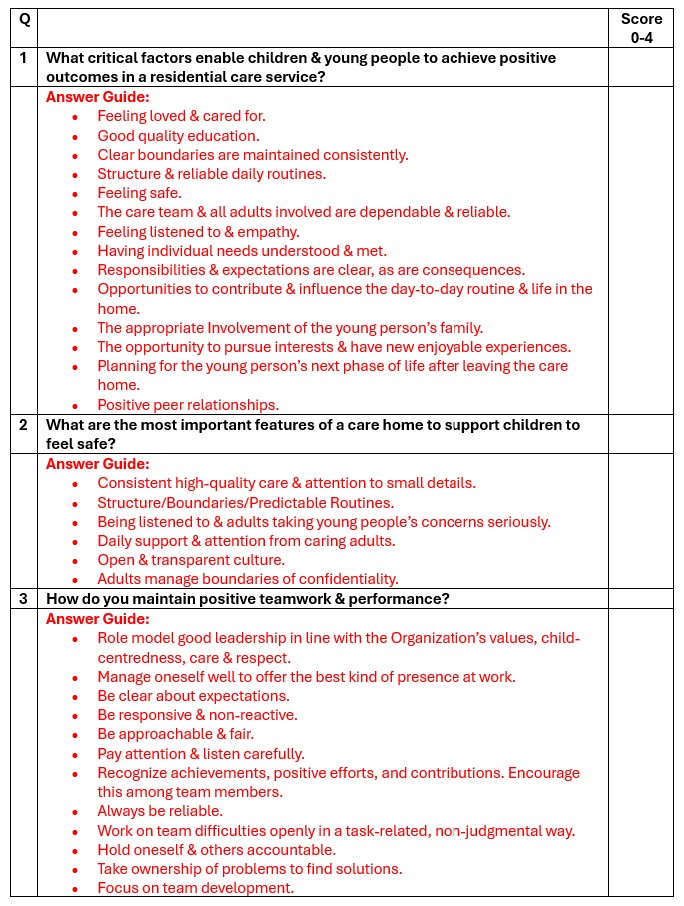
6-8 QUESTIONS explored fully may be sufficient. For any round of interviews for a specific role, ensure that all candidates are asked the same questions.)
APPENDIX 2: PROBING DURING AN INTERVIEW
During an interview, probing refers to the interviewer's technique of asking follow-up questions to get a deeper understanding of a candidate's initial answers. It's essentially a way to dig beneath the surface of what’s been said and gain further details. Here are some reasons why interviewers probe:
• To clarify something unclear: Maybe the candidate used an ambiguous or technical term, or you just want to be sure you fully understood their point.
• To get more details: If an answer is brief, probing questions can encourage the candidate to elaborate on their experiences, skills, or thought process.
• To fully assess a competency, the Interviewer might probe to see a concrete example of how the candidate used a particular skill they mentioned.
Probing questions can take many forms, but some common examples include:
• "Can you tell me more about that?"
• "What was your specific role in that project?"
• "What challenges did you face in that situation?"
By using probing effectively, interviewers can get a better picture of a candidate's skills and experience and determine if they are a good fit for the role. Probing questions offer advantages for both the interviewer and the interviewee during an interview. Here's a breakdown of the benefits for each side:
Advantages for the Interviewer
• Deeper Understanding of Skills and Experience: Probing goes beyond one-word answers or surface-level explanations. It allows the interviewer to truly understand how the candidate has applied their skills in past situations and the thought processes behind actions.
• Uncovering Hidden Gems: You might mention a relevant skill or experience briefly. Probing can help the interviewer delve deeper and uncover valuable details that might have otherwise been missed.
• Assessing Fit for the Role: By probing how a candidate handled specific challenges or projects, the interviewer can gauge how well their strengths and experiences align with the specific demands of the position.
• Identifying Red Flags: Probing can sometimes reveal inconsistencies or weaknesses in responses. This allows the interviewer to get a clearer picture of suitability for the role.
Overall, probing fosters a more in-depth and interactive interview experience, allowing both parties to gain valuable insights that lead to a better fit between candidate and role.
Training in Interview Techniques
Interviewing is a skilled practice. To ensure the highest quality of outcomes and to prevent discrimination and bias, there should be training for those involved. The alternative is a sterile and limited process, based more on preventing any allegation of discrimination rather than selecting the best person to do the job (Warner, 1992). All staff selection processes must ensure fairness and anti-discrimination. Training on these issues is essential to reduce the risk of unconscious prejudice.
Warner (1992, p.61) states,
We consider that it is essential that those conducting interviews are properly trained to undertake them. No person should be allowed to take part in interviews without having received thorough training in interviewing techniques and the proper application of equal opportunities policies.
And (p.62),
Employers should only assign people to interview panels if they have had the appropriate training, and should consider the use of external assessors when it is difficult to appoint a panel without an independent element.
Reference
Warner Report (1992) Choosing with Care - The Report of the Committee of Inquiry into the Selection, Development and Management of Staff in Children's Homes, HMSO
APPENDIX 3: FURTHER INFORMATION & RECOMMENDATIONS FROM THE WARNER REPORT
The Warner Report, formally titled "Choosing with Care" (1992), was an influential UK government inquiry chaired by Norman Warner. It was established in response to public concern over abuse and poor standards in children’s residential care, specifically focusing on the selection, recruitment, management, and development of staff in children's homes.
While the Warner investigation and recommendations took place over 30 years ago, much of what was in it is very relevant and helpful today.
Report Background and Purpose
The inquiry emerged after a series of high-profile investigations into misconduct in children’s homes over several decades. Its task was to recommend practical improvements to ensure children in care were safeguarded from abuse and to address failings in recruitment and training practices.
Key Themes and Recommendations
Safer Recruitment: The report emphasized the need for rigorous safer recruitment and vetting processes for staff, such as routine police checks, comprehensive employment history checks, external advertisement of posts, and reference checks before appointment.
Warner Interview: It gave rise to the "Warner Interview," an in-depth process designed to assess a candidate’s personal motivations, attitudes, and suitability for working with vulnerable children. This method involves probing questions about applicants’ emotional awareness, self-reflection, and boundaries, aiming to prevent the appointment of individuals who might pose a risk to children.
Lasting Influence
The Warner Report set a new national standard for safeguarding in children’s residential services and informed subsequent reports and legislation, such as the Care Standards Act 2000, shaping modern safer recruitment, supervision, and vetting practices.
Below are some of the recommendations from the Warner Report that are worth considering today. While the needs of each job and context are variable, and we might not agree with all of Warner's recommendations, we should at least consider all the key areas and be clear about the reasons for what we do or don’t put in place. Paying attention to the staff selection process is one of the most valuable and impactful exercises to influence organizational success.
The tools and techniques discussed below are all designed to increase the information gathered about candidates and to evaluate it more effectively. (Warner, 1992, p.45)
“An employer commented that,
"Our procedures rely upon good sense, gut reactions, and sharing the decision-making." Warner states, “We consider that it is possible to make the selection of staff more systematic and objective than this”.
The Institute of Personnel Management (IPM) noted in its written evidence that, on its own, the interview is not a good predictor of future job performance. Research findings quoted in the evidence suggested that the interview has a validity coefficient of 0.14 (i.e., only 14 in 100 appointments based on interviews will meet employers' expectations on job performance). The IPM commented that this is somewhat worse than making decisions on the toss of a coin. (Warner, 1992, p.45)”
The numbering and quotes in this section are taken directly from Warner so that anyone interested can go directly to the section in the Warner Report.
1. CANDIDATE INFORMATION AND THE ASSESSMENT PROCESS
4.1 Too often, insufficient information is obtained on candidates; there is excessive reliance by most employers on the chance performance of a candidate at a formal interview. They need to draw upon a wider range of selection techniques to obtain a fuller picture of candidates.
4.2 The process of assessment should be aimed at gaining a full picture of a candidate's personal attributes, skills, and experience.
4.3 Most appointments are made based on an application form and a formal interview. In many cases, the interviews are conducted in panels of four or more people, which is hardly a forum for exploring aspects of personality.
4.6 The aim should be to achieve a full and rounded picture of the candidate, providing more detailed and complete information than is possible with the traditional application form-interview system.
2. WRITTEN EXERCISES
4.12 Muddled managers produce confused staff. Staff who cannot express themselves clearly are likely to make young people in their care confused and possibly angry. Irrational responses to children and young people are likely to worsen problems of control in homes. Most managers and many staff have to write reports, and many of these affect children's future. All this suggests that the selection process should test candidates' ability to think clearly and to express themselves well, both orally and in writing.
4.13 Written exercises can be designed to test clarity of thought and expression, and some respondents to our survey want to see more use of written exercises. The qualities mentioned are particularly important for posts where there is a significant management element. Exercises should take the form of asking applicants to write a short piece on a subject relevant to residential child care practice or management. Candidates should be asked to complete the written exercise and return it with the application form. The subject of the written exercise should be sent out with the application form, and should state a maximum length of reply. Usually, 1,000 words should be a sufficient length.
4.14 (Written exercises) will provide evidence not only of candidates' ability to think clearly and to express themselves cogently, but will often reveal underlying attitudes… Responses should be drawn upon later in the selection process, most appropriately in an interview or discussion with the candidate… Candidates should be told at the outset that their written exercises will be discussed in the interview.
Recommendation 10
Employers should use written exercises in the selection process (including shortlisting) to test the ability of candidates to think clearly and to express themselves.
3. HOME VISITS (This may be a sensitive issue and not always appropriate.)
4.15 An important initial stage of the selection process should always be a visit to the home. We believe that, if properly planned, these visits are a valuable source of information both about and for the candidate. Candidates will be able to reconsider their own application in the light of their experience on these visits, and the employing authority will be able to observe the interaction between candidates and staff and children.
Requirement to attend additional selection processes, such as visits.
4.16 This can only be achieved if the employing authority pays the necessary expenses of candidates, including costs of travel and, where necessary, of overnight accommodation. This will, of course, involve extra costs for the employer, but avoiding inappropriate appointments will save money in the long term.
Recommendation 11
Employers should require all shortlisted candidates to visit the home and meet the staff and children in advance of the interview. Information about the interaction on visits between candidates and staff, and children should be made available to those involved in deciding the appointment of candidates by a person involved in the appointment process.
4. GROUP EXERCISES
4.19 We recognise that effective simulation of work in a children's home will be extremely difficult to achieve. However, it should be possible to simulate the environment in the home and to consider how candidates respond to it. The most appropriate means of doing so is through group exercises and discussions.
4.20 Three forms of group exercises can be identified: with other candidates, with staff, and with children. The latter two, to a certain extent, overlap with visits to children's homes, and there is scope for combining these two exercises. This may take the form of, for example, asking candidates for a head of home post to chair a staff meeting, or allowing candidates to be questioned by the young people in the home.
5. PSYCHOMETRIC TESTS
4.29 In an article in 1991, Blinkhorn and Johnson argued that it rarely happens that better selection or promotion decisions are made when personality tests are used. Six experts replied to their article. Professor Clive Fletcher of the University of London asserted that "It is extremely difficult to see any justification for the Blinkhorn and Johnson view on statistical, empirical, conceptual or practical grounds". He went on to say that personality tests can never be seen as a stand-alone method of selection, but are useful when taken in conjunction with other approaches and, perhaps most important of all, when the users have been properly trained. This is very much the position taken by the British Psychological Society in their evidence to us, although they have also emphasised that tests need to be adapted for the setting in which they are to be used.
4.30 The professional advice given to us is that reputable personality tests do give a reasonably accurate picture of the so-called "big five" elements of personality -extroversion, emotional stability, agreeableness, conscientiousness, and culture. Some will argue that these "big five" are too crude to be used for personnel selection. It is true that they are not the only factors in choosing people for a job. However, they are important considerations in choosing people to work in children's homes - particularly emotional stability, agreeableness, and conscientiousness. If reliable tests are available for assessing these factors, then it would seem perverse not to use them. They enable interviewers to ask more probing questions about the responses received.
4.31 The other main argument used against personality tests is that they have not been validated against staff's subsequent performance. Although there are few studies in this, we are aware of a four-year study of 750 managers in two different types of organisation (a bank and an electrical engineering company) completed in 1991. This reported a high correlation between the results of personality profiles and subsequent performance.
4.35 We recognise that there has been a level of resistance to the introduction of personality tests. We note also that in many local authorities, personality profiling is used in the selection of senior staff, although it is much less common in more junior grades. Some 17% of local authorities make some use of them for head of homes posts, but only 5% of authorities reported using them 'sometimes' for care staff. However, their use is much more common in the voluntary sector, and within the private sector, less than half the homes say they never use these tests for either heads of homes or care staff.
4.36 In our view, personality tests should be used to help determine the extent to which a candidate fits a person specification. This will invariably have been prepared to require that candidates have certain characteristics and an affinity to work in the particular environment of a children's home. Initially, therefore, we are recommending that personality profiling is used for heads of homes and other management posts in homes, as a means of gaining a fuller picture of the candidates. However, we recognise that the field of personality testing is continually developing, and we consider that it is important that the potential for tests to be used in selecting staff in children's homes should be further explored. The British Psychological Society has stated in their evidence that they are not able to endorse any psychometric tests that are not specifically adapted to the recruitment and selection of staff in children's homes. This points to the need for more development work to be encouraged by the Department of Health and employers.
6. CANDIDATE REFERENCES
4.43 In our view, appointments should never be made 'subject to references'. Prospective new employers should take the initiative in obtaining information about candidates from previous employers or line managers before the final interview. Previous employers have the information that enables a new employer to form a rounded picture of a candidate's strengths and weaknesses, and this information should be sought by letter and telephone. Information obtained by telephone is often more accurate and revealing, and to forbid the obtaining of it by this means through some misguided view of equal opportunities policies is simply to neglect the interests and safety of children. We consider that local authorities should abandon any embargoes on obtaining information about candidates by telephone.
7. SHORTLISTING
4.54 Shortlisting is an important part of the selection process and should be seen to be undertaken fairly and objectively. Theoretically, there is little difficulty in one person undertaking the shortlisting process if the person specification and application form have been properly designed. However, we recognise that many employers will consider that the process can only be undertaken fairly and equitably by a shortlisting panel, as is current practice. We recommend, therefore, that the shortlisting panel should comprise three people, ideally those who will be responsible for taking the final decision on appointment. There should always be an element independent of the line management of the post on the panel, but line managers should always take part in shortlisting candidates. As far as practicable, the panel should be balanced by gender, and the racial balance should reflect the local population. This is particularly important as many of the respondents to our survey reported failing to achieve gender and ethnic balance on interview panels.
Recommendation 20
Employers should ensure that, wherever possible, shortlists have at least three candidates; that shortlisting panels should include line managers and a person independent of the line management of a home; and that the panel should have no more than three members, balanced by gender and, where appropriate, race.
8. COMPOSITION AND SIZE OF THE INTERVIEW PANEL
4.56 We consider that panels should always contain the line manager for the post, his or her line manager, and at least one other person independent from line management. One of these people should be the designated appointing officer for the post.
4.58 Large interviewing panels are unwieldy and tend to achieve little in terms of gaining further information about a candidate. Evidence suggests that there is little need for more than two people on an interviewing panel. In practice, we recognise that in a large organisation such as a local authority, this is likely to be unrealistic. We consider that interviewing panels should include a maximum of three people. All those who will be involved in making the final appointment decision should be involved in the formal interview.
9. THE TRAINING OF INTERVIEWING PANELS
4.62 Interviewing is not necessarily a skill that everyone possesses. Our survey shows that most local authorities have recognised this. Interview training is generally provided for elected members, and 80% of local authorities report it as "always" or "usually" provided for officers who interview. In the independent sector, only about one-third of those interviewing have been trained to do so. We consider that it is essential that those conducting interviews are properly trained to undertake them. No person should be allowed to take part in interviews without having received thorough training in interviewing techniques and the proper application of equal opportunities policies.
Recommendation 21
Employers should ensure that final interview panels consist of no more than three people, balanced by gender and race as far as possible and appropriate, and should include an independent person as well as the line manager and a person senior to the line manager, one of whom should be authorised to make the appointment.
Files
- Download a Free PDF of this article
- Download 18 Interview Questions and Guidelines
- Download Warner Choosing with Care Recommendations
- Downlaod Interview Probing
Please leave a comment
Next Steps - If you have a question please use the button below. If you would like to find out more
or discuss a particular requirement with Patrick, please book a free exploratory meeting
Ask a question or
Book a free meeting