












THE IMPORTANCE OF PRIMARY TASK AND CORE VALUES CLARITY - PATRICK TOMLINSON (2026)
Date added: 16/08/26
Download a Free PDF of this article
An Example from Therapeutic Residential Care for Children and Young People
Introduction
This is a short article to explain why the primary task, core values, and their alignment are so important. I will explain how this helps to establish a strong culture and how strong leadership is essential to maintain and develop the culture. Clarity on these issues is essential for ongoing positive outcomes.
 One of my areas of work is helping organizations build therapeutic models for children and young people who have suffered trauma and other adversities. The work always begins in the same place: being clear about the organization’s primary task and the core values that support it. These two concepts – primary task and core values – are directly relevant to any field of work and enterprise. This short article outlines why the relationship between the two is so important to underpin organizational effectiveness and success.
The Primary Task
An organization can be described as a system, or a set of activities, with a boundary and a purpose. The primary task is the task the organization must perform above everything else – the reason it exists (Miller and Rice, 1967, p.25; Rice, 1963, p.17). For organizations working with traumatized children, the stakes of getting this wrong are high, so clarity is essential: the primary task might be to safely contain children, or to enable them to recover from their experiences. Naming it precisely changes everything about how the organization operates, and staying ‘on task’ requires constant vigilance in the face of the pressures the work brings.
Core Values and Why They Matter
Core values function as guiding principles, and they need to underpin – and stay closely tied to – the primary task. They should be embedded in everything the organization does. Any proposed core value should be tested against a single question: does it help or hinder the primary task? If the primary task is X, a value only belongs in the organization if it serves X.
Most organizations settle on somewhere between three and six values. The way the values are worked upon and agreed, and who is involved, is very important. Values only take hold if people feel they own them, which means involving as many stakeholders as possible – employees and service-users – in agreeing what they are.
Research on residential childcare points to a strong culture as one of the central factors behind good outcomes for children, and that culture is, in essence, a set of core values lived out daily (Clough, Bullock and Ward, 2006). A strong staff culture leads to a strong culture among the young people in care, which in turn leads to better outcomes.
Strong Culture
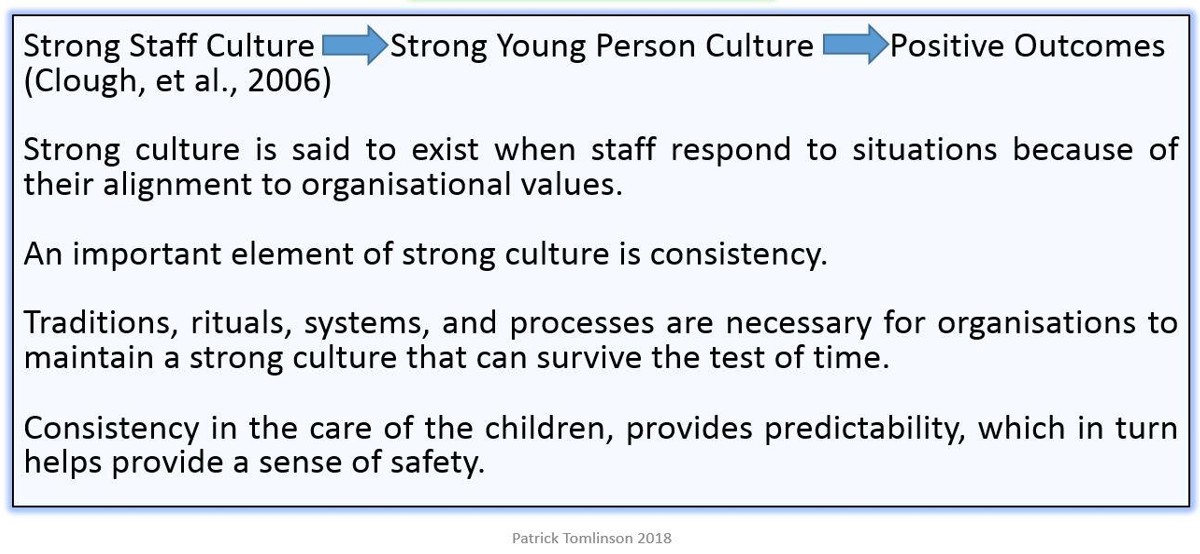
Strong culture exists when staff respond to situations in alignment with organizational values; consistency is a critical part of that, sustained by the traditions, rituals, systems, and processes that enable a culture to survive over time. For children in care, that consistency provides predictability, and predictability provides a sense of safety.
Interestingly, some organizations build strong cultures without ever explicitly naming their core values – the values evolve organically and become embedded regardless. But defining them deliberately has a real advantage. Once written down, values can be communicated to children, staff, families, placing authorities, and prospective employees, thereby establishing a clear, shared set of standards. Values embedded into recruitment, supervision, and performance management operate as a genuine operating tool, not just a statement on a wall or in a policy folder.
Core Values in Practice
Working out core values together starts with a simple question: what are the most important things for us to embody in everything we do?
A core value might be Open Communication – defined, for clarity, as communication that is respectful, transparent, and honest. Beyond that broad definition, descriptors can help translate the value into daily practice, such as,
• Staff will have the courage to communicate openly about difficulties and challenges.
• We will support children to be open about their lives and feelings.
• We will communicate openly with families and social workers about our work.
• We will give feedback and honest answers to questions in a way that is respectful to individuals and groups.
Kindness could be a second value, with a definition along the lines of: we endeavor to do our work, however difficult, with kindness and empathy. An organization’s values naturally reflect its task. Creative organizations tend to value innovation and risk-taking; customer service organizations value customer focus. A global travel company (Carlson Wagonlit Travel), for instance, had the following six core values.
• Customer Care – putting the needs of clients first and continuously providing an outstanding level of service.
• Commitment to Excellence – continuously seeking higher levels of performance.
• Cultural Diversity – fostering respect and team spirit, embracing the company’s multicultural character, and providing equal opportunity to talented individuals.
• Reliability – being a dependable, trustworthy business partner committed to industry-leading products and services.
• Entrepreneurial Spirit – approaching new challenges with creativity, resourcefulness, and agility.
• Integrity – building longstanding relationships by being truthful and promoting open communication.
Methods, Tools, and Organization
Once the primary task and values are clear, the methods, tools, and organization can be designed in a way that is most effective. The therapeutic approach, the resources used, and how they are organized should all be the best possible fit for the primary task. Both the clinical methods used with children and the way the wider organization operates need to work in service of that task. The organizational culture has to support and complement the direct work with children and young people. None of this works without a theoretical understanding of the links between the primary task, methods, and outcomes. Theory must be translated into practice.
Keeping the Primary Task and Core Values Aligned
A strong, shared set of core values creates congruence in the best interests of the child (Anglin, 2002) throughout an organization. There is not one set of values for how carers are expected to work and a different set for managers. Whatever an organization wants reflected in its frontline work has to be reflected everywhere else in the organization too. Ultimately, core values earn their place only by staying most relevant to the work itself – to the primary task and mission the organization exists to deliver.
However sophisticated the methods, they will only work if they sit inside a culture where everyone understands the primary task and shares the same core values. Staying on task depends on clear management and leadership. As Whitwell (2009, p.3) put it,
Therapeutic communities need to have leaders who are clear about the primary task and are knowledgeable about therapeutic work with emotionally disturbed children.
They also give the organization a way to notice when things start to slip – reducing the risk of ‘values drift’ or ‘task drift’ (for example, risk management overshadowing therapeutic recovery work) before it takes hold. Talking about how difficult it can be in a children’s trauma service to prevent drift and anti-task culture developing, Menzies Lyth (1985, p.254) states,
There appears to be a need for constant vigilance if the defence system operated in the institution is to be sustained at a mature level and indeed to be adaptive rather than defensive, for it will be under constant threat.
In any field of work or industry, there is always a risk of losing focus on the primary task and values that underpin it. This is especially so when the primary task is difficult and anxiety-provoking for all involved. The primary task and values are likely to be severely tested by the nature of the work, and this makes their clarity vital. We need to constantly remind ourselves of the primary task and core values, for example, by always testing whether our decisions are in line with them or not.
References
Anglin, J. (2002) Pain, Normality, and the Struggle for Congruence: Reinterpreting Residential Care for Children and Youth, New York: The Haworth Press Inc.
Clough, R., Bullock, R. and Ward, A. (2006) What Works in Residential Child Care, London: NCERCC and National Children’s Bureau
Menzies Lyth, I. (1985) The Development of the Self in Children in Institutions, in Containing Anxiety in Institutions: Selected Essays Vol. 1. London: Free Association Books (1988). Reprinted from J. Child Psychotherapy (1985) 11: 49-64
Miller, E.J. and Rice, A.K. (1967) Systems of Organization: The Control of Task and Sentient Boundaries, London: Tavistock Publications
Rice, A.K. (1963) The Enterprise and Its Environment: A System Theory of Management Organization, London: Tavistock Publications
Whitwell, J. (2009) Why a Therapeutic Community Approach? (or “What did I learn from my 27 years working in a therapeutic community that I have found to be useful in other settings?”), a talk given at the Making All the Difference: A Therapeutic Community Approach to Residential and Community Care Conference, 9 March, Carlow College, Carlow, Eire
Files
Please leave a comment
Next Steps - If you have a question please use the button below. If you would like to find out more
or discuss a particular requirement with Patrick, please book a free exploratory meeting
Ask a question or
Book a free meeting